


Agentic AI in Marketing: Use Cases, Benefits, and Real-World Examples
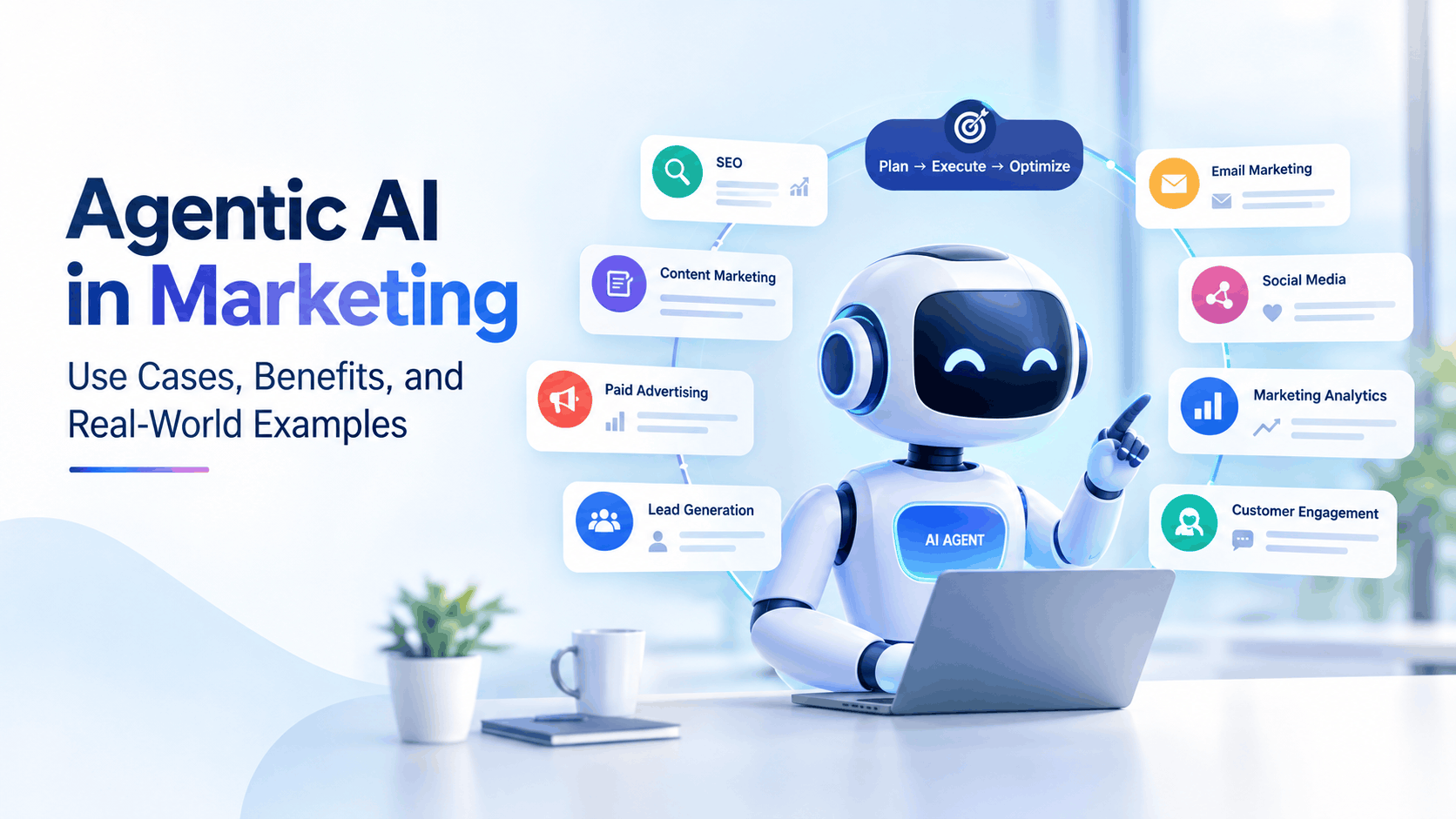
Digital marketing involves many interconnected activities, including search engine optimization (SEO), content creation, paid advertising, social media management, email campaigns, and lead generation. Managing these activities efficiently requires marketers to analyze performance data, identify opportunities, and make timely decisions.
Traditional automation helps businesses complete repetitive tasks, while generative AI can produce content and suggest ideas. Agentic AI takes the process further by helping systems analyze information, determine appropriate next steps, and execute defined tasks within established rules and permissions.
For businesses looking to improve campaign performance and operational efficiency, Agentic AI in Marketing offers a way to connect data, decisions, and actions across digital marketing activities.
In this guide, we explore how AI agents can support everyday marketing tasks, practical use cases, potential benefits, implementation challenges, and examples of how businesses can apply this technology responsibly.
What Is Agentic AI in Marketing?
Agentic AI refers to AI systems that can work toward a defined goal by gathering information, evaluating situations, selecting actions, and carrying out tasks using connected tools and workflows.
In marketing, an AI agent might monitor campaign performance, identify a decline in conversions, investigate possible causes, and recommend corrective actions. Depending on its configuration and permissions, it may also implement approved changes and monitor the results.
This is different from using an AI tool simply to generate a blog outline or summarize a report. An agentic system can coordinate multiple steps toward an objective rather than responding to a single instruction.
For example, a marketing team might set a goal to improve qualified leads from organic search. An AI agent could review landing-page performance, identify content gaps, suggest SEO improvements, and prepare tasks for the content team. Actions that affect publishing, budgets, or customer communications can remain subject to human approval.
According to Salesforce’s guide to AI marketing agents, marketing agents can support activities such as audience segmentation, personalization, campaign execution, and workflow coordination.
The key distinction is that an agent combines analysis with action. Its effectiveness depends on the quality of its data, the tools it can access, the boundaries it follows, and the oversight provided by the marketing team.
How Agentic AI Helps in Digital Marketing
The most valuable applications of Agentic AI in Marketing are practical: identifying opportunities, coordinating workflows, responding to changing performance, and reducing manual work. The following use cases show how AI agents can support different parts of a digital marketing strategy.
1. AI Agents for SEO and Search Performance
SEO requires ongoing research, technical monitoring, content improvement, and performance analysis. These activities often involve multiple tools and considerable manual effort.
AI Agents for SEO can help marketers organize these tasks and respond to changes more efficiently.
Potential applications include:
- Keyword and topic analysis: Review keyword performance, search intent, and existing content to identify potential opportunities.
- Technical SEO monitoring: Flag indexing issues, broken links, missing metadata, and other technical problems for investigation.
- Content gap analysis: Compare existing website content with relevant topics and questions that the audience may be searching for.
- Performance monitoring: Analyze changes in impressions, clicks, rankings, and organic conversions to identify pages that may need attention.
- SEO task coordination: Turn identified issues into prioritized recommendations for content writers, developers, and SEO specialists.
For example, suppose a service page receives fewer organic clicks than usual. An AI agent could flag the decline, examine available Search Console data, compare recent performance, and identify possible explanations. It could then recommend reviewing the page title, search intent, competing results, or technical accessibility.
The agent should not automatically rewrite every page or change important website settings without appropriate checks. Search performance can fluctuate for many reasons, and a decline in traffic does not always mean a page needs a content update.
Businesses should also continue following established search fundamentals. Google’s SEO Starter Guide explains the principles behind making website content accessible and useful to search engines and visitors.
2. Content Marketing and Optimization
Content marketing involves more than producing articles. Marketers must identify audience needs, research topics, maintain brand consistency, update existing pages, and distribute content through relevant channels.
AI agents can coordinate parts of this workflow, helping teams move from research to production and performance review.
Possible applications include:
- Researching audience questions and relevant content topics.
- Preparing article briefs based on search intent and business objectives.
- Checking drafts against brand guidelines and content requirements.
- Identifying older articles that may need updated information.
- Repurposing approved content into email newsletters and social media posts.
- Monitoring engagement and recommending future content improvements.
For instance, an agent could identify a high-performing blog post, suggest related articles, prepare social media variations, and organize a newsletter draft. A content editor could review the material before publication.
Content teams can also connect these workflows with their approach to Generative Engine Optimization (GEO), which focuses on making content useful and accessible in AI-powered search experiences.
The goal is not to publish more content simply because AI makes production faster. It is to create relevant, accurate, original material that addresses real customer questions.
3. Paid Advertising and Campaign Optimization
Paid campaigns require ongoing monitoring of impressions, clicks, conversion rates, cost per acquisition, and return on advertising spend. Campaign managers must identify underperforming ads and decide where adjustments may be appropriate.
Agentic systems can support this process by monitoring performance against predefined targets and coordinating recommended actions.
Use cases include:
- Flagging advertisements with declining conversion rates.
- Comparing performance across campaigns, audiences, and channels.
- Identifying potential budget inefficiencies.
- Suggesting alternative ad copy or creative variations.
- Preparing experiments to test different landing pages or calls to action.
- Monitoring results after approved changes.
Consider a campaign that continues to attract clicks but generates fewer leads. An agent could compare traffic quality, landing-page performance, conversion tracking, and audience behavior. It might recommend testing a clearer call to action or reviewing the lead form before suggesting a budget adjustment.
This type of workflow reflects the broader possibilities described in Salesforce’s practical guide to agentic marketing, which covers campaign creation, optimization, and personalization.
Budget changes and campaign launches should follow predefined spending limits and approval rules. Automated decisions based on incomplete tracking data or short-term fluctuations can waste money rather than improve results.
4. AI-Driven Lead Generation and Qualification
Lead generation often involves collecting inquiries, identifying promising prospects, assigning leads to the right team, and following up at the appropriate time.
AI-Driven Lead Generation can help coordinate these steps by analyzing available engagement data and applying qualification rules established by the business.
Potential applications include:
- Reviewing form submissions and identifying missing information.
- Categorizing leads according to predefined qualification criteria.
- Identifying prospects who have repeatedly engaged with relevant pages or emails.
- Routing qualified inquiries to the appropriate sales representative.
- Preparing personalized follow-up drafts.
- Flagging leads that require human review.
For example, a B2B company may receive inquiries from visitors who download a guide, explore service pages, and request a consultation. An AI agent could combine permitted engagement signals with the company’s qualification criteria, classify the inquiry, and route it to the appropriate sales team.
The system could also prepare a summary of the prospect’s stated needs so that the sales representative can respond more effectively.
However, engagement does not automatically indicate purchase intent. Businesses should use transparent qualification rules, respect consent requirements, and avoid making consequential decisions based on unreliable or sensitive personal information.
A well-structured website is also essential to this process. Learn more about how a business website supports marketing, sales, and customer support.
5. Email Marketing and Personalization
Email marketing requires audience segmentation, message creation, campaign scheduling, and continuous performance evaluation. AI agents can help coordinate these activities using customer preferences, engagement history, and campaign objectives.
Practical applications include:
- Preparing email variations for different audience segments.
- Suggesting subject lines and calls to action.
- Identifying subscribers who may need a different follow-up sequence.
- Recommending suitable content based on permitted customer preferences.
- Monitoring opens, clicks, conversions, unsubscribes, and other relevant metrics.
- Flagging campaigns that require further testing or review.
For example, an agent could identify subscribers who clicked a product announcement but did not complete the intended action. It might prepare a follow-up email with additional information or a relevant resource for review.
With appropriate integrations and permissions, an agent could also coordinate the next step in a customer journey based on predefined conditions.
Personalization should remain useful and proportionate. Businesses need to protect customer data, honor communication preferences, and ensure that automated messages are accurate and appropriate.
6. Social Media Marketing
Social media marketing requires a steady flow of relevant content, timely responses, audience engagement, and performance analysis. AI agents can help marketers coordinate these activities without removing the need for creative judgment.
Possible applications include:
- Monitoring engagement patterns and relevant audience discussions.
- Identifying content themes that may deserve further attention.
- Preparing platform-specific captions and content variations.
- Organizing a publishing calendar.
- Categorizing incoming comments for review.
- Tracking engagement and referral traffic across campaigns.
For example, an agent could notice that educational posts consistently attract more meaningful engagement than promotional posts. It could recommend testing additional educational content and prepare draft posts for the team’s review.
Agents can also help flag negative feedback or customer questions that need a timely response. Sensitive complaints, legal issues, and reputational concerns should be escalated to a person rather than handled automatically without oversight.
AI-generated content still needs to reflect the brand’s voice and audience expectations. Businesses can review common social media mistakes that can hurt engagement when building a more structured content process.
7. Marketing Analytics and Reporting
Digital marketing teams often gather data from analytics platforms, advertising dashboards, CRM systems, and email marketing tools. Reviewing these sources separately can make it difficult to understand what is driving results.
AI agents can help bring relevant information together, highlight meaningful changes, and prepare reports for decision-making.
They may be configured to:
- Summarize campaign performance against defined objectives.
- Identify unusual changes in traffic, engagement, or conversions.
- Compare results across channels and reporting periods.
- Flag missing or inconsistent tracking data.
- Prepare reports with explanations and recommended next steps.
- Monitor whether previously approved changes are producing the expected results.
Imagine an online business experiences a sudden decline in website conversions. An agent could flag the change, check whether traffic sources or landing-page conversion rates have shifted, and identify potential tracking problems. It could then prepare a summary of the findings and recommend what the team should investigate next.
This is more useful than simply reporting that conversions have fallen. However, an agent’s explanation is a hypothesis until the available evidence supports it. Marketers should validate findings before changing campaigns or drawing business conclusions.
8. Cross-Channel Marketing and Customer Journeys
Customers may interact with a business through organic search, paid advertisements, email, social media, and its website. Coordinating these touchpoints can be challenging when data and workflows are disconnected.
Agentic systems can help connect activities across channels by responding to defined customer actions and coordinating the next appropriate step.
For example, a customer might read a blog post, visit a service page, and submit an inquiry. Depending on the business’s consent settings and workflow rules, an agent could help record the inquiry, route it to sales, prepare a relevant follow-up, and monitor whether the lead progresses.
This is where AI Marketing Automation can become more adaptive. Rather than relying exclusively on fixed sequences, an agentic workflow can evaluate new information and select from approved next steps.
The business should still define the journey, establish communication rules, and decide which actions require approval. Connected systems and reliable data are essential; an agent cannot coordinate a customer experience effectively when key information is missing or inconsistent.
Real-World Examples of Agentic AI in Digital Marketing
Agentic AI capabilities are developing across marketing platforms, but the following scenarios illustrate potential applications rather than claim that a particular company has deployed an identical workflow.
Example 1: An e-commerce advertising campaign
An online retailer sets a target cost per acquisition and defines limits for campaign spending. An agent monitors campaign performance, flags advertisements that exceed the target, investigates available conversion data, and recommends adjustments. A marketing manager reviews the recommendations before significant budget changes are applied.
Example 2: A B2B lead generation workflow
A software company receives inquiries from several website forms. An agent categorizes submissions using approved qualification criteria, summarizes each prospect’s stated requirements, and routes qualified inquiries to the appropriate sales representative. The sales team can then prioritize follow-up using consistent information.
Example 3: An SEO content improvement process
A digital marketing team monitors organic traffic and conversions across its website. An agent flags pages with sustained performance changes, compares available search and analytics data, and prepares recommendations for updating content or investigating technical issues. An SEO specialist validates the findings before changes are published.
Example 4: A personalized email journey
A business defines different follow-up paths based on permitted engagement signals. An agent helps prepare relevant message variations, monitors responses, and recommends the next approved step. The team can review campaign performance and refine the rules over time.
These examples demonstrate how AI agents can connect multiple marketing tasks. Actual results depend on the quality of integrations, the reliability of data, the design of workflows, and the level of human supervision.
Key Benefits of Agentic AI for Digital Marketing
When implemented carefully, agentic systems can help marketing teams improve their operations in several ways.
Greater operational efficiency
Agents can reduce repetitive work involved in gathering data, preparing reports, organizing tasks, and coordinating campaign steps. This can give marketers more time for strategy, creative development, and customer understanding.
Faster identification of opportunities
Continuous monitoring can help teams identify changes in campaign performance or customer engagement sooner. Faster detection does not guarantee better outcomes, but it can help marketers investigate issues before they persist.
More consistent personalization
Agents can help adapt content and follow-up workflows to relevant customer segments and permitted engagement signals. This makes it easier to manage variations across campaigns while maintaining defined brand and compliance rules.
Better coordination across channels
When connected to appropriate systems, agents can help coordinate activities that would otherwise require manual handoffs between SEO, advertising, email, sales, and analytics teams.
More structured optimization
Agents can track predefined objectives, prepare recommendations, and monitor outcomes after approved changes. This supports a more systematic approach to testing and improvement.
The value of AI-Powered Digital Marketing should ultimately be measured through business outcomes rather than the number of automated tasks. Useful indicators include qualified leads, conversion rates, cost per acquisition, customer retention, campaign efficiency, and revenue contribution.
Agentic AI vs. Traditional Digital Marketing Automation
Traditional automation and agentic AI can work together, but they serve different purposes.
| Area | Traditional automation | Agentic AI |
|---|---|---|
| Workflow | Follows predefined triggers and rules. | Can evaluate context and choose from permitted actions. |
| Decision-making | Usually depends on configured conditions. | Can assess information and recommend or select next steps. |
| Adaptability | Changes typically require rule or workflow updates. | Can respond to new information within its defined boundaries. |
| Example | Send an email three days after a download. | Evaluate permitted engagement signals and recommend an appropriate follow-up. |
| Oversight | Depends on workflow design and risk. | Requires clear permissions, monitoring, and escalation rules. |
Traditional automation remains useful for predictable, repeatable tasks. Agentic AI may be more appropriate when a workflow requires several connected steps, changing information, or decisions based on context.
In practice, AI Marketing Automation and agentic workflows are complementary. A business can use conventional automation for reliable, rule-based activities and agents for tasks that benefit from contextual analysis and coordinated action.
Challenges and Best Practices for Implementation
Agentic AI can introduce operational risks if businesses grant systems too much autonomy or rely on inaccurate information. A practical implementation should address the following challenges.
Data quality and integration
Agents need access to relevant, accurate information. Inconsistent CRM records, incomplete conversion tracking, and disconnected marketing platforms can lead to misleading conclusions.
Start by identifying the data and systems required for one specific workflow. Confirm that the information is reliable and that integrations work as expected.
Privacy and security
Marketing systems may process customer details, browsing activity, and engagement records. Businesses should use appropriate access controls, follow applicable privacy requirements, and ensure that customer data is handled according to their policies.
Accuracy and brand consistency
AI agents may produce inaccurate information, misunderstand context, or generate content that does not match the brand. Use approved information sources, clear brand guidelines, testing, and human review for public-facing content.
Unintended actions and financial risk
An agent with permission to change advertising budgets, publish content, or contact customers can create problems if its decisions are incorrect.
Set spending limits, define allowed actions, maintain activity logs, and require approval for high-impact changes. Test workflows before allowing them to operate on live campaigns.
Measuring actual performance
Automation does not automatically lead to more revenue or better marketing performance. Establish a baseline and define success metrics before implementation. Compare results over a suitable period and account for other factors that may influence performance.
A practical way to get started
- Choose one business problem. For example, identifying underperforming landing pages or organizing incoming leads.
- Define the objective. Set measurable targets such as faster lead routing, fewer reporting hours, or improved conversion rates.
- Identify required data and tools. Confirm what the agent needs to access and which actions it is permitted to take.
- Set boundaries and approvals. Decide which tasks can be automated and which require human review.
- Test with a limited workflow. Check accuracy, reliability, and handling of unusual cases before expanding.
- Measure and refine. Review results against the baseline and adjust the workflow based on evidence.
This phased approach helps businesses understand where agentic systems provide value without introducing unnecessary complexity.
The Future of Agentic AI in Digital Marketing
Digital marketing is moving toward workflows that combine data analysis, content support, personalization, and task execution. As tools and integrations mature, AI agents may take on more coordination across marketing platforms and customer journeys.
However, progress will depend on more than the capabilities of the AI model. Businesses will need reliable data, secure integrations, well-defined responsibilities, and teams that can evaluate results and manage automated systems.
The role of marketers is therefore likely to involve more than producing individual assets or manually reviewing dashboards. Strategy, creative judgment, customer understanding, governance, and performance evaluation will remain essential.
Businesses that approach AI-Powered Digital Marketing with clear objectives and appropriate oversight will be better positioned to assess where agentic workflows can support their operations. The focus should be on solving meaningful marketing problems, not adopting AI simply because it is available.
Agentic AI offers a way to connect analysis and execution across SEO, content marketing, advertising, lead generation, email, social media, and analytics. By coordinating defined tasks and responding to changing information, AI agents can help marketing teams reduce manual work and make more informed decisions.
The best starting point is a focused use case with reliable data, measurable objectives, and clear boundaries for automated actions. Businesses should test the workflow, evaluate its results, and expand only when there is evidence that it provides value.
At Sigur Solutions, we believe effective digital marketing combines the right strategy, technology, and continuous improvement. If your business is exploring ways to strengthen its digital marketing operations, connect with Sigur Solutions to discuss a strategy aligned with your goals.