Website Conversions: Why Visitors Leave and How to Turn Traffic Into Leads
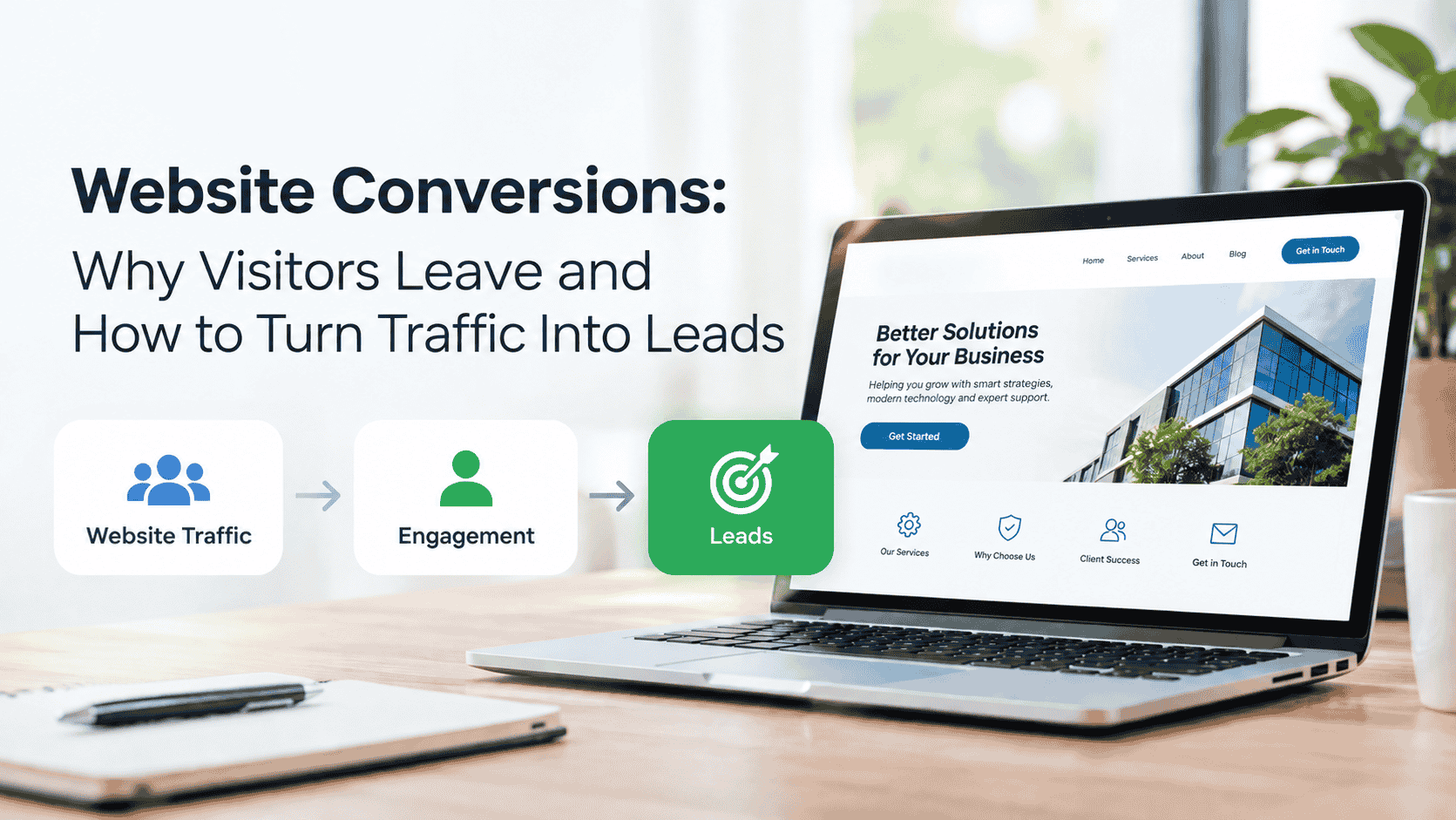


Getting traffic to your website is important, but traffic alone does not generate business. If visitors arrive, browse a few pages, and leave without contacting you, requesting a quote, booking a consultation, or making a purchase, your website may have a conversion problem.
Website conversions are the actions you want visitors to take after arriving on your site. Depending on your business, a conversion could be a form submission, phone call, appointment booking, purchase, demo request, or another meaningful action.
The goal of website conversion optimization is simple: help more of the visitors you already attract take the next step.
Visitors rarely leave for just one reason. Poor user experience, unclear messaging, weak calls to action, slow pages, and a lack of trust can all create friction.
Recent conversion research continues to identify unclear value propositions, weak CTAs, poor navigation, slow experiences, and complicated lead capture as common barriers between website traffic and conversions.
Understanding these problems can help you identify where your website is losing potential leads.
When someone lands on your website, they should quickly understand what your business offers, who you help, and why they should consider you.
A headline such as “We Deliver Excellence” does not tell visitors much.
Instead, your main message should communicate a specific benefit and make your offering easy to understand.
Ask yourself: Can a first-time visitor understand what my business does within a few seconds?
If the answer is no, unclear messaging may be hurting your website conversions.
A website can look attractive but still be difficult to use.
Visitors may struggle with confusing navigation, crowded layouts, difficult-to-read content, intrusive pop-ups, or poorly organized information.
Good website user experience should make it easy for visitors to move from one step to the next.
Your navigation should be logical, important information should be easy to find, and each important page should have a clear purpose.
Visitors may be interested in your service but still leave because they do not know what to do next.
A generic “Submit” or “Click Here” button provides little motivation.
Use clear, action-oriented calls to action such as:
Place relevant CTAs where visitors naturally make decisions, rather than forcing them to search for a contact option.
Website performance affects the overall user experience. A slow-loading page can create frustration before visitors even see your offer.
Mobile usability is equally important. Visitors should be able to read your content, navigate your pages, tap buttons, and complete forms comfortably from a smartphone.
Google’s Search Central documentation also emphasizes page experience and provides guidance for how websites can improve their search appearance and technical implementation.
Review your important landing pages regularly on both desktop and mobile devices.
Visitors need a reason to believe that your business can deliver what it promises.
Trust signals can include:
Place appropriate trust signals close to important conversion points. When visitors are deciding whether to contact or purchase from you, reassurance can make the next step easier.
Long or complicated forms can discourage potential customers.
If someone only wants to request a consultation, asking for extensive information may create unnecessary friction.
Start by identifying what information your sales team genuinely needs at the first stage. Keep the form simple and make it easy to complete on mobile.
For higher-intent prospects, additional information can be collected later in the customer journey.
Not every visitor arrives at the same stage of the buying journey.
Someone searching for general information may not be ready to request a quote. Someone visiting a pricing or service page may have much stronger purchase intent.
Your content and CTAs should reflect these differences.
For example, an educational blog post might encourage visitors to explore a related guide, while a service page can use a stronger CTA such as Request a Consultation.
Matching content with visitor intent can help improve website engagement and conversions.
Improving website conversions does not necessarily mean rebuilding your entire website.
Start by analyzing where visitors are dropping off. Review analytics data, conversion paths, landing-page performance, form submissions, and CTA interactions to identify the biggest problems.
Then prioritize improvements such as:
Clarify your message: Make your value proposition immediately understandable.
Improve navigation: Help visitors find important information quickly.
Strengthen CTAs: Give every important page a clear next step.
Build trust: Add relevant reviews, testimonials, case studies, and credentials.
Optimize mobile experience: Make pages, buttons, menus, and forms easy to use on smaller screens.
Simplify forms: Remove unnecessary fields and reduce friction.
Match content to intent: Give visitors information and CTAs appropriate to where they are in the buying journey.
These improvements form the foundation of effective conversion rate optimization.
Website traffic is useful, but it should not be your only success metric.
Track actions that contribute to business growth, including:
Compare these actions against your traffic to understand your website conversion rate and identify opportunities for improvement.
A website that attracts fewer visitors but converts those visitors effectively can generate more business than a website with large amounts of traffic and very few leads.
Your website should do more than attract visitors. It should help those visitors understand your business, build confidence, and take the next step.
If your website is generating traffic but not enough enquiries or sales, focus on website conversions rather than simply trying to attract more visitors.
Clear messaging, better user experience, stronger CTAs, trust signals, mobile optimization, simpler forms, and relevant content can remove the barriers that prevent visitors from taking action.
Ultimately, successful website conversion optimization is about making it easier for the right visitors to become leads—and giving your business more value from the traffic you are already generating.